
Retail · Pilot
Cameras watch.
Software checks the shelf.
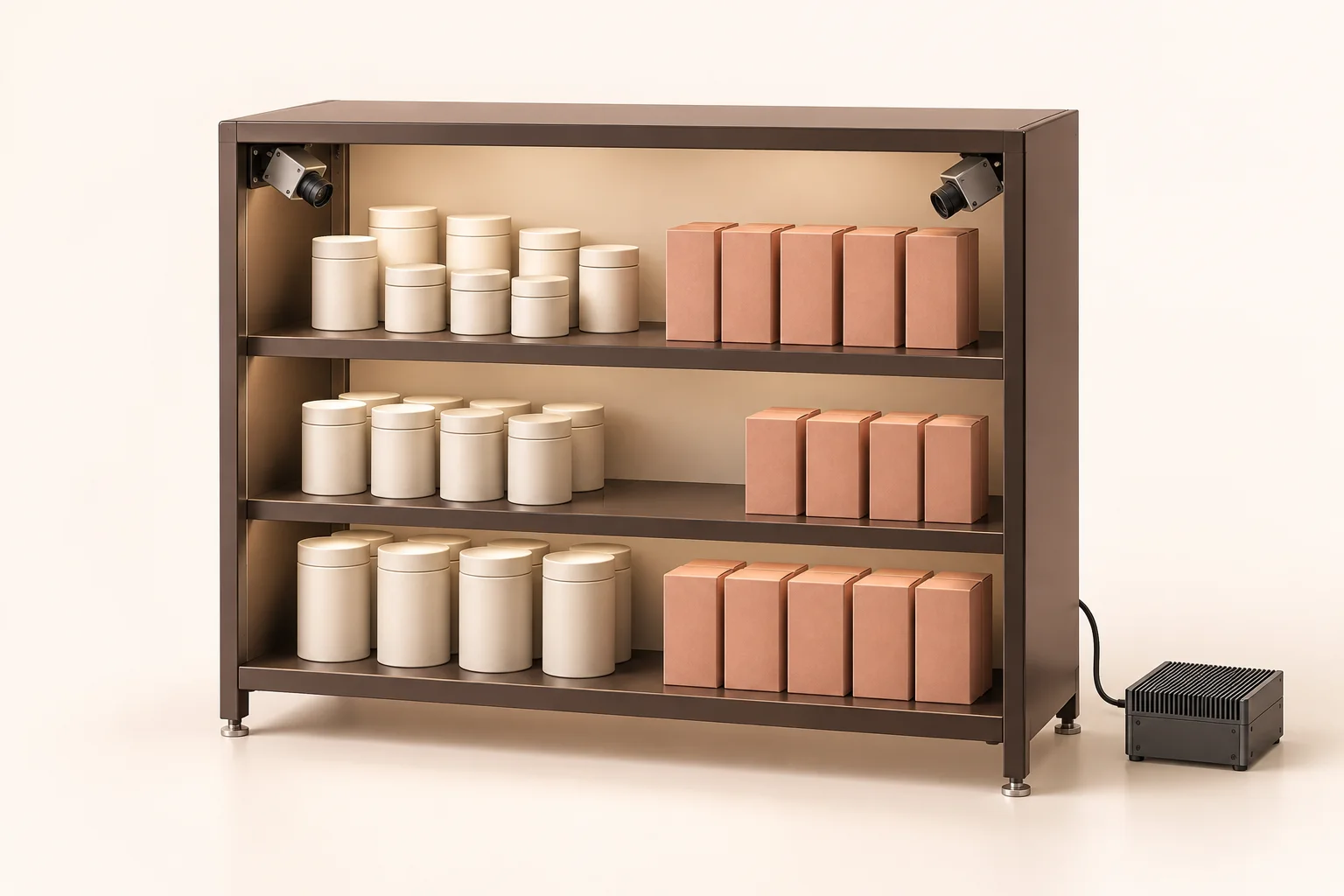
This pilot explores how to identify and count products from images of a retail cabinet. Model quality depends on the cabinet’s physical configuration.
Illustrative engineering scenario. This is not a client case study or proof of Novera delivery.
- 01Define regions
- 02Recognise & count
- 03Review in the interface
A frame passes through several systems
The path starts with a camera and its position. It continues through region mapping, recognition and counting models, an API, the backend and the interface.
If a region has not been mapped or compute is unavailable, the result will not reach the user. An end-to-end test is needed even after the model passes an isolated test.
A new viewing angle needs its own test
Product position and the visible side of a package change on the shelf. Reflections can hide the features that distinguish one product from another.
Performance on familiar frames does not answer the question about a new camera position. The pilot needs a separate test set and distinct evaluations for recognition and counting.
What the pilot evaluates
The workflow connects cameras, ML processing and a user interface. Evaluation covers the complete cycle, counting accuracy and operation in the cabinet’s actual configuration.
This is pilot work with hardware and models. The engineering question is whether results can be reproduced as image-capture conditions change.
Recognition and counting are evaluated for a specific cabinet configuration, including camera positions, reflections and region mapping. Such a demonstration helps define the next evaluation.
What do you want to build?
Tell us about your project and current system. Let’s discuss how we can work together.