
Manufacturing · System design
Spot a defect
on a moving line.
An operator checks packaging as it moves along a production line. Automation starts with understanding which defects a camera can see and how to inspect them without slowing the line.
Illustrative engineering scenario. This is not a client case study or proof of Novera delivery.
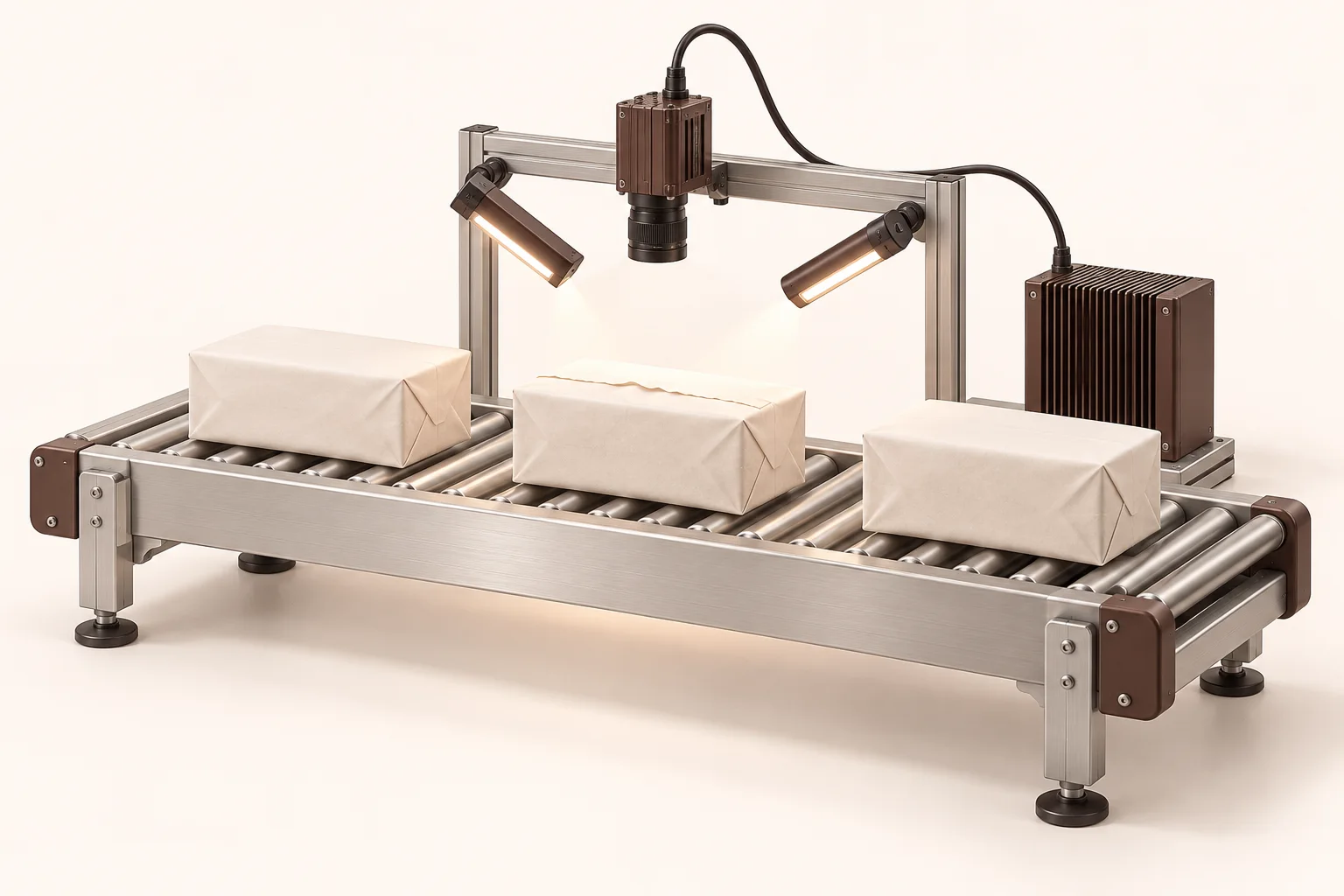
- 01Capture frame
- 02Inspect region
- 03Review event
Define defects before choosing a model
The requirements cover shifted film, missing production codes, protruding edges and seam defects. Each type needs an example and a clear rule for classifying a defect.
The viewing angle and lighting determine whether the relevant area is visible at all. Image capture belongs in the system design alongside the model.
Process images close to the line
The proposed architecture separates local edge processing from a central system. Image capture, model execution and event handling can then be examined individually.
The action following a signal needs to be defined in advance. Inspecting an image, rejecting a package and stopping a line are different tasks with different integration requirements.
The design work
This scenario covers inspection requirements and architecture: which defects to check, where to process frames and how an event reaches the operator.
Testing on the line requires images from its actual camera. Those images are used to measure missed defects, false alarms and processing time.
Defect and line requirements are connected to local processing and a central system. This gives a team a basis for choosing what to test on real images and estimating the next stage.
What do you want to build?
Tell us about your project and current system. Let’s discuss how we can work together.